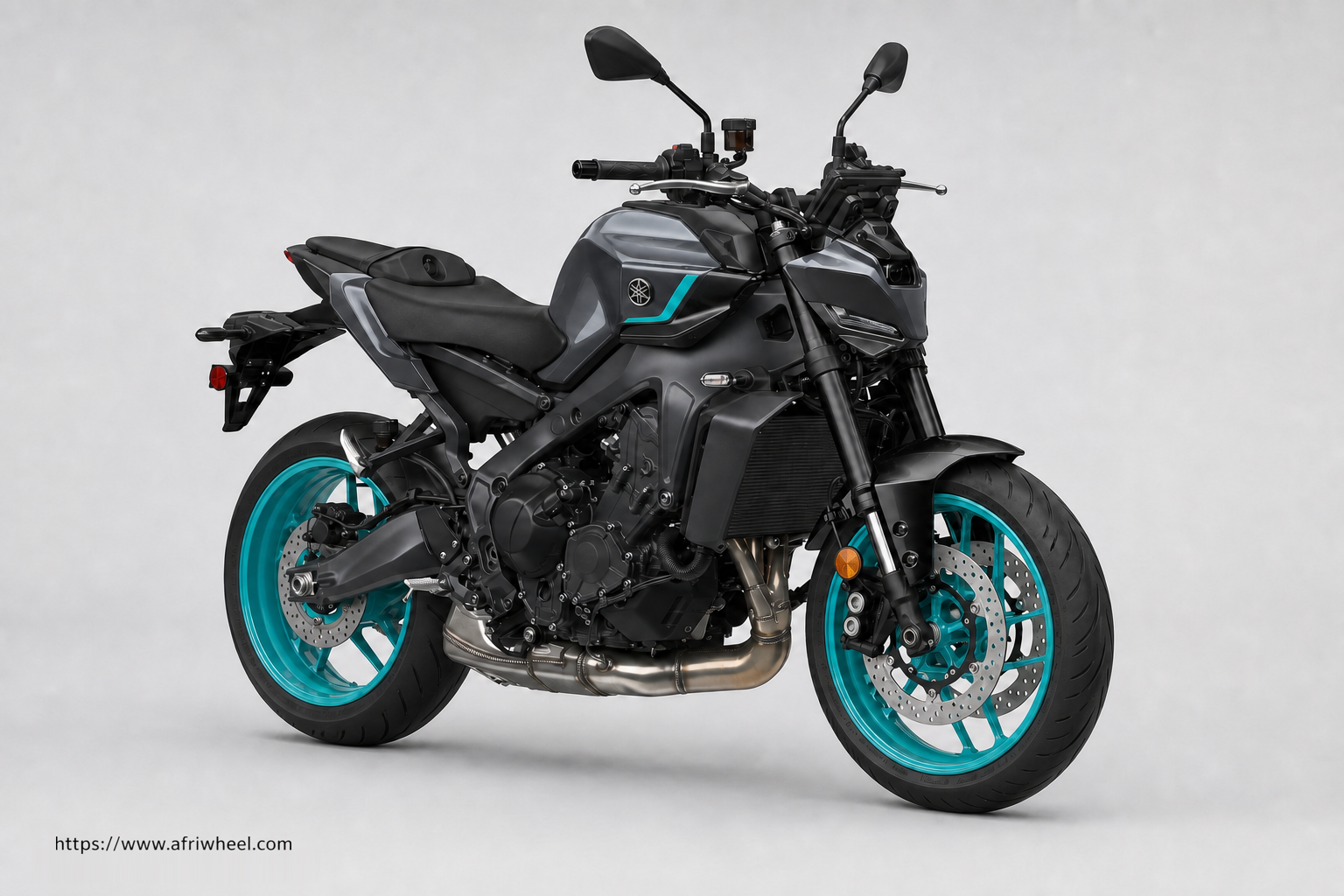
MT-09 buyer overview
The MT-09 enters the South African comparison as a street motorcycle in Yamaha's current South African range, with MT-09, MT-09 Y-AMT, and MT-09 SP forming the exact derivative set. Its strongest fit is specific rather than universal: experienced street riders wanting strong three-cylinder performance and a broad electronic rider-aid suite. Its limitations begin with learners, buyers seeking full touring bodywork or riders prioritising the lowest purchase and insurance costs. The rest of this overview uses locally linked facts to explain that fit, separating confirmed hardware from features or ownership promises that have not been established for this market.
Its power-unit evidence gives a useful mechanical outline: engine capacity 890 cc, and cooling Liquid-cooled. The drive record adds gear count 6, and final drive Chain. These figures explain architecture and operating controls; they do not constitute an independent performance test. Peak output, where published, should be read with the rpm point and transmission rather than turned into an unsupported acceleration claim. Likewise, a tank figure is a capacity, not a guaranteed range. Route, load, speed, wind, terrain and maintenance condition can change consumption materially, so a buyer should avoid calculating a precise travel distance unless a compatible local consumption figure is also available.
The MT-09 range does not have one common dimension or mass figure that can be quoted across every mapped derivative. That is a variant difference, not a reason to average incompatible values. Open the exact derivative record before comparing seat height, wheelbase, clearance or weight, then confirm the delivered machine in person. Seat profile, suspension sag, footwear and rider proportions affect reach, while fuel, luggage and accessories affect operating mass. Storage and transport checks should use the chosen derivative's real width, height and complete load.
Handling-related facts are clearest when grouped. Structure and suspension provide only a limited set of locally confirmed details; braking information gives front disc diameter 298 mm, and rear disc diameter 245 mm; wheel fitment gives front wheel diameter 17 inches, and rear wheel diameter 17 inches. None of these entries is treated as a road-test conclusion. Long travel can support bump absorption while increasing seat height, and large brakes can still be limited by tyre grip or surface. A setup discussion with the dealer or technician should cover sag, adjusters, pressure, controls and load. Replacement pads, discs, tubes or tyres should be ordered from exact specifications rather than chosen only because a visually similar Yamaha uses them.
Visible technology and practical equipment are documented as local-use status Listed in Yamaha South Africa's road-motorcycle catalogue. In contrast, ABS, traction control, instrument display, phone and navigation support, and under-seat storage cannot be promoted from the reviewed evidence alone. The distinction matters because regional specifications often share styling while differing in electronics, lighting or convenience hardware. Ask for a written equipment list tied to the VIN or exact competition product. Connected navigation should be checked on a real South African route and phone. Any storage, rack, screen or protection accessory needs its own capacity, fitment and warranty confirmation rather than being folded into the standard model description.
The useful question around MT-09 is how its road package fits the rider's real mix of congestion, open roads and weekend use. Seat reach, throttle response, clutch or automated-shift behaviour, steering leverage and wind exposure can matter more day to day than the largest headline number. Training, protective equipment and an insurance quote should be part of the shortlist, particularly where the engine output and tyre capability place the machine beyond an entry-level commuter.
The range contains 3 mapped derivatives: MT-09, MT-09 Y-AMT, and MT-09 SP. Each should be opened separately because transmission, equipment and observed price can differ even when bodywork and engine family appear similar. Current mapped derivative observations run from R234,950 to R269,950, with the latest check dated 2026-08-10. These are derivative-specific vehicle-price references, not a promise of an on-road total; fees, accessories, insurance and finance remain separate. A useful comparison sheet should put the exact derivative name, model year, transmission, standard equipment, colour, warranty, service requirements and all fees on one line. That prevents an attractive monthly repayment from hiding a longer term, deposit, balloon payment or excluded cost. It also prevents a discounted older unit from being mistaken for the current specification. A written quotation should identify any optional accessories separately and say whether fitment changes warranty, mass, dimensions or intended use.
Some commonly requested details are not safely published for the MT-09. In the principal buyer groups, the absent fields include engine cycle, cylinder layout, maximum power, power peak, maximum torque, torque peak, transmission, and clutch. Those blanks should be handled as questions for Yamaha or an authorised dealer, never as zero values or evidence that equipment is absent. They also should not be filled from a similarly named US, European or Australian model unless Yamaha documents exact equivalence. The locally mapped use statement is Listed in Yamaha South Africa's road-motorcycle catalogue. Warranty duration, service intervals, payload, towing, emission or noise values require their own exact South African evidence before they can influence an ownership score.
Taken as a whole, the MT-09 makes the strongest case for experienced street riders wanting strong three-cylinder performance and a broad electronic rider-aid suite. It should move down the list for learners, buyers seeking full touring bodywork or riders prioritising the lowest purchase and insurance costs. The final decision should follow a physical fit check, a representative test or supervised evaluation where permitted, an insurance or transport plan, and a written quote for the exact derivative. Compare only confirmed like-for-like facts, then let personal fit and operating context decide between otherwise credible choices. That approach keeps the model's real strengths visible without turning an incomplete brochure field into a marketing promise.