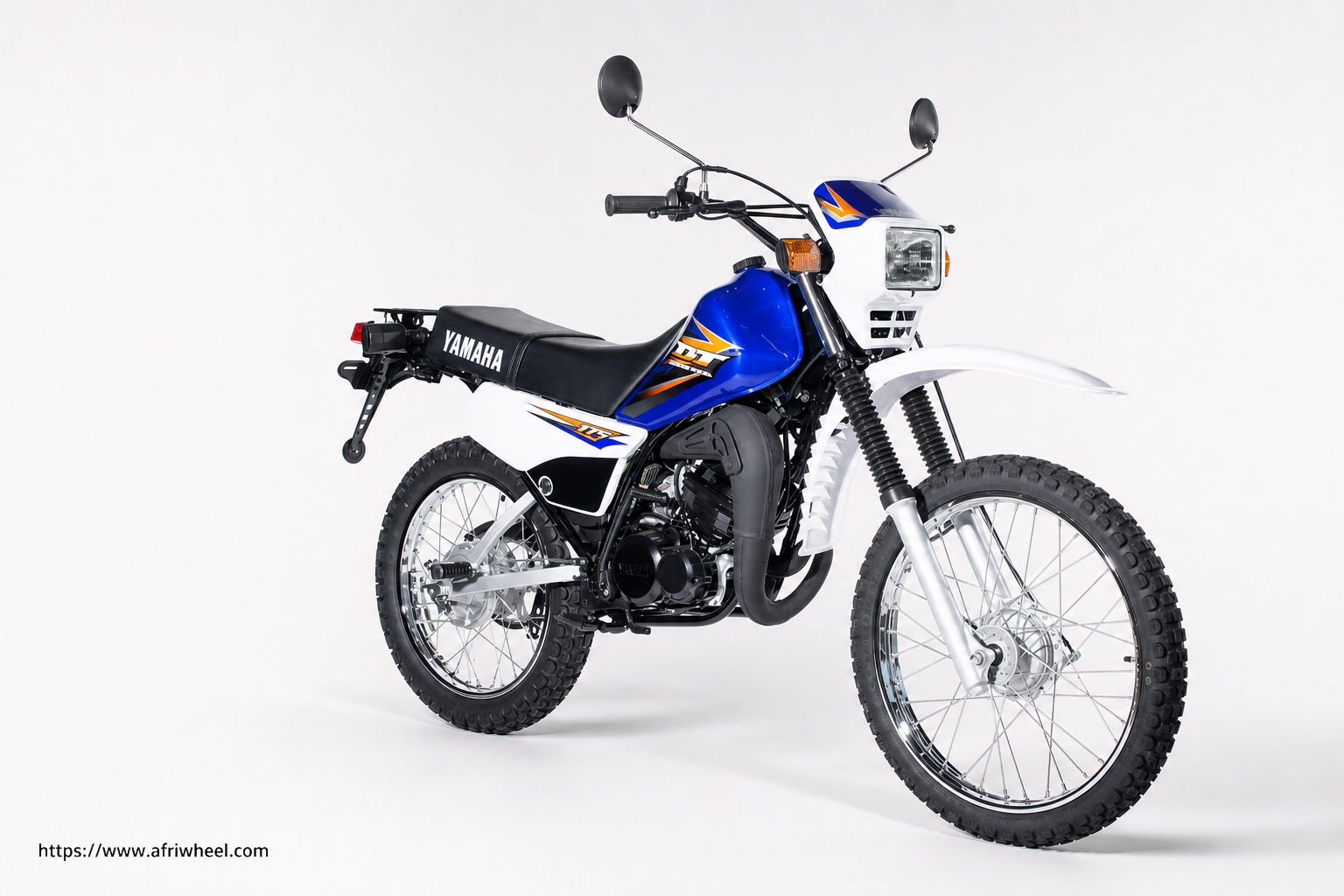
DT175 buyer overview
Within Yamaha's South African selection, the DT175 fills the role of a dual-purpose motorcycle in Yamaha's current South African range. The model page covers DT175, with each derivative retaining its own transmission, price and equipment evidence. Its intended buyer is private-land and agricultural users wanting a light two-stroke work motorcycle with simple serviceable hardware. The opposing consideration is equally important: it makes less sense for buyers requiring road registration, low-emission four-stroke operation or modern electronic equipment. Reading the model this way creates a useful shortlist based on purpose, rider fit and operating environment instead of relying on styling alone.
For propulsion, the locally linked facts read engine capacity 171 cc, engine cycle 2-stroke, cylinder layout Single cylinder, cooling Air-cooled, maximum power 12.9 kW, power peak 7,000 rpm, maximum torque 18.6 Nm, and torque peak 5,500 rpm. Transmission and fuel information add transmission Constant-mesh 6-speed manual, gear count 6, and fuel capacity 9.5 litres. This is enough to place the DT175 mechanically without pretending to reproduce a road or track test. It would be unsafe to infer a performance curve, cruising range or service burden from these entries alone. A prospective owner should ask how the documented transmission behaves in the intended terrain, whether clutch operation suits the rider, what fuel is specified, and which maintenance tasks become time- or distance-critical in the matching owner or competition manual.
Size is one of the most practical parts of the DT175 decision. Confirmed values include overall length 2,110 mm, overall width 865 mm, overall height 1,165 mm, wheelbase 1,340 mm, ground clearance 260 mm, seat height 830 mm, and kerb weight 107 kg. They frame garage space, loading, seat reach and terrain clearance, but do not produce an automatic verdict on manageability. Rider inseam, strength, technique, suspension setup and surface camber all change the experience. A static showroom check should be followed by the most representative permitted test available. For off-road transport, measure the actual machine at its widest and tallest points and include fuel, guards, luggage or other fitted equipment in the loading plan.
The chassis evidence records front suspension Telescopic fork, and rear suspension Swingarm. Braking and control hardware add front brake Drum, and rear brake Drum, while the wheel-and-tyre set is described by front wheel diameter 21 inches, rear wheel diameter 18 inches, front tyre 2.75-21 45P, and rear tyre 4.10-18 59P. Those details should be considered as a system. Travel does not by itself grade suspension quality, a disc diameter does not establish stopping distance, and a tyre size does not confirm the brand fitted at delivery. Adjustment, spring rate, pressures, compound, surface and rider input all influence the result. Before handover, inspect wheel condition, brake operation and tyre date codes, then use Yamaha's exact pressure and setup guidance for load and intended use.
The verified convenience and technology picture is local-use status Not eligible for on-road registration. Important items without a safe local claim include ABS, traction control, instrument display, phone and navigation support, and under-seat storage. This separation avoids rewarding one product merely because its brochure is more detailed. Buyers should ask the dealer to demonstrate every promised display, key, light, riding mode or phone function on the exact unit before delivery. Where connectivity is present, check device support and recurring costs. Where road eligibility is restricted, lighting equipment does not override that status. Accessories should be itemised with part numbers and warranty treatment on the final order.
For DT175, terrain and legality must be defined before discussing value. Wheel sizes, clearance, suspension movement, seat height and tyre construction shape confidence on loose surfaces, while fuel capacity, vibration, luggage provision and wind protection affect longer transfers. Where the local record says the machine is not eligible for road registration, that restriction rules out public-road commuting regardless of lights or visual resemblance to a road motorcycle. Private-land users should still confirm landowner rules, training, protective gear and transport arrangements.
There is one mapped derivative, DT175, so the model decision is mainly about suitability, colour, dealer terms and any accessories rather than a trim ladder. The recorded South African price observation is R79,950, described as dealer advertised, and was checked on 2026-08-10. It is a vehicle-price reference rather than a promise of an on-road total; registration, delivery, finance, insurance, accessories and dealer preparation require separate confirmation. A useful comparison sheet should put the exact derivative name, model year, transmission, standard equipment, colour, warranty, service requirements and all fees on one line. That prevents an attractive monthly repayment from hiding a longer term, deposit, balloon payment or excluded cost. It also prevents a discounted older unit from being mistaken for the current specification. A written quotation should identify any optional accessories separately and say whether fitment changes warranty, mass, dimensions or intended use.
Some commonly requested details are not safely published for the DT175. In the principal buyer groups, the absent fields include clutch, final drive, claimed fuel consumption, published dry weight, frame, front suspension travel, rear suspension travel, and front disc diameter. Those blanks should be handled as questions for Yamaha or an authorised dealer, never as zero values or evidence that equipment is absent. They also should not be filled from a similarly named US, European or Australian model unless Yamaha documents exact equivalence. The locally mapped use statement is Not eligible for on-road registration. Warranty duration, service intervals, payload, towing, emission or noise values require their own exact South African evidence before they can influence an ownership score.
Taken as a whole, the DT175 makes the strongest case for private-land and agricultural users wanting a light two-stroke work motorcycle with simple serviceable hardware. It should move down the list for buyers requiring road registration, low-emission four-stroke operation or modern electronic equipment. The final decision should follow a physical fit check, a representative test or supervised evaluation where permitted, an insurance or transport plan, and a written quote for the exact derivative. Compare only confirmed like-for-like facts, then let personal fit and operating context decide between otherwise credible choices. That approach keeps the model's real strengths visible without turning an incomplete brochure field into a marketing promise.