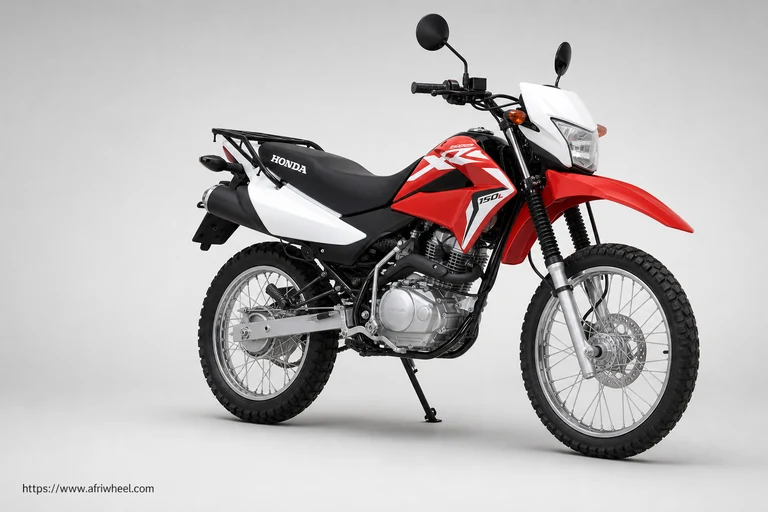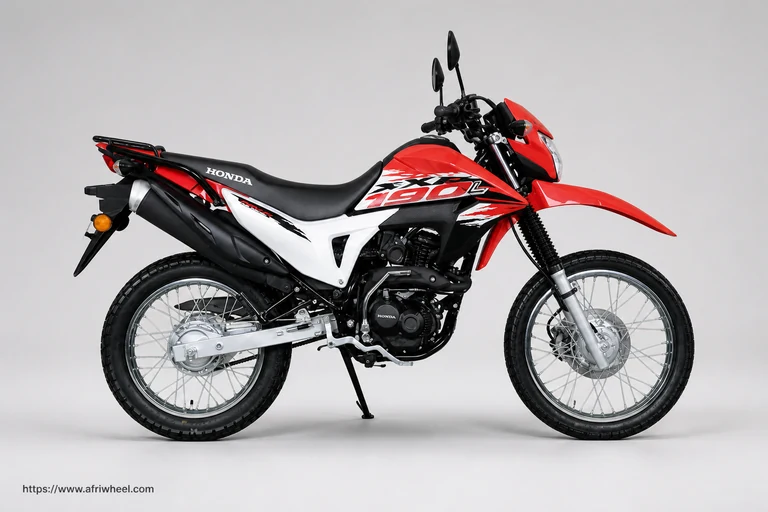
XR125L buyer overview
Market identity
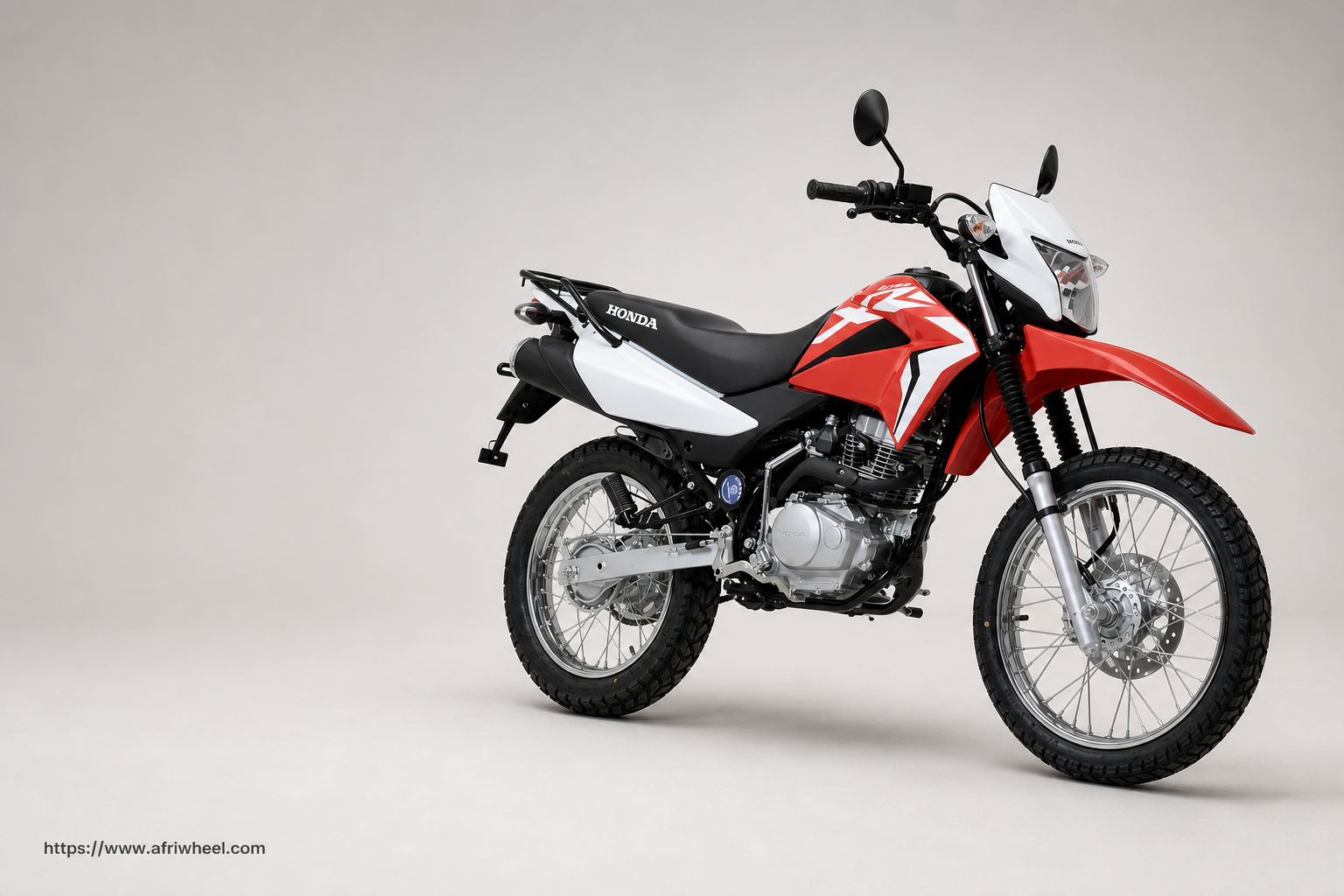
Honda Motor Southern Africa places the XR125L in its dual purpose catalogue and describes a product that is a simple small-capacity dual-purpose bike for urban travel and maintained unsealed roads. The identity matters before any number is compared: AfriWheel has tied this record to the South African product page, its linked specification sheet, the 2026 listing and the named local derivatives. A similarly titled motorcycle from Europe, Asia or another African distributor is not treated as interchangeable. This separation protects the XR125L page from generation drift, imported trim names and equipment claims that Honda has not made for South Africa.
Range and pricing
The reviewed XR125L line-up records XR125L at R42,899. The lowest published amount is therefore R42,899, but that number is a manufacturer-recommended retail reference rather than a complete on-road quotation. Stock timing, registration, delivery, accessories, paint charges, insurance, finance and a retailer promotion can change the transaction. The useful comparison is the cash amount for the full derivative name, followed by an itemised list of additions. AfriWheel dates the XR125L price observation to 4 August 2026 so a future change can create history instead of silently overwriting what shoppers previously saw.
Purpose and shortlist fit
The clearest reason to shortlist the XR125L is its stated role: a simple small-capacity dual-purpose bike for urban travel and maintained unsealed roads. That positioning is a starting hypothesis, not a promise that the motorcycle suits every route or body shape. A useful decision maps the intended week—commuting distance, passenger use, luggage, surface quality, parking, fuel access and highway exposure—against the physical machine. The XR125L should be assessed alongside alternatives serving the same job, rather than against an unrelated motorcycle chosen only because its price or engine badge appears close. Fit and control reach remain personal and need a static inspection or test ride where appropriate.
Engine and performance record
For the XR125L, the confirmed power-unit evidence presently includes engine type of Four-stroke, engine configuration of Single-cylinder, engine displacement of 125 cc, engine cylinders of 1, and cooling system of Air-cooled. These are descriptive specifications, not an AfriWheel acceleration or top-speed claim. Output numbers need their stated units and engine speed, while displacement alone cannot establish overtaking ability, refinement or fuel use. Where Honda's South African material omits a value, AfriWheel leaves that XR125L field in the research ledger. It is not reconstructed from an overseas brochure, an owner forum or a class average. That distinction lets readers see what the manufacturer actually supports for the named market.
Transmission and energy use
The XR125L source map records transmission type of Manual, and final drive type of Chain. Transmission labels are kept derivative-specific because manual, CVT, DCT and E-Clutch operation are materially different even when a family name is shared. Fuel capacity is not the same as practical range, and neither proves consumption without a stated test method. Before ordering the XR125L, ask how the selected transmission operates at walking speed, what routine drive maintenance applies, which fuel grade is specified and whether the published service schedule changes with severe use. These questions turn a catalogue description into an ownership plan without inventing unsupported efficiency estimates.
Brakes, wheels and tyres
The confirmed braking record for the XR125L contains brake dimensions and electronic-aid detail that the reviewed source set does not establish; the wheel and tyre record contains wheel, tyre and pressure data that should be confirmed on the delivered machine. Rotor diameter or caliper branding cannot independently predict stopping distance, because tyre condition, surface grip, mass and control input remain central. ABS and combined braking are separate technologies and are never inferred from one another. On the physical XR125L, confirm that tyre sizes and ratings match the documentation, inspect manufacture dates and damage, and establish the correct cold pressures for solo and loaded riding. For off-road products, verify the intended terrain and do not assume public-road legality from fitted lights or brakes.
Controls and practical equipment
The XR125L equipment evidence includes lighting, instrumentation, connectivity and carrying details not stated by the reviewed local documents. AfriWheel treats a feature as standard only when the exact-country source establishes it; accessory availability is a separate question. Storage volume, display size, charging ports, navigation and lighting can be useful, but their relevance depends on the rider's routine. During inspection, operate the controls with gloves, view the display in daylight, check phone compatibility where listed and place normal luggage in the available carrying area. Request a quotation that separates factory equipment from dealer-fitted additions so the delivered XR125L can be checked against what was promised.
Evidence strengths and limits
Two source-backed highlights currently anchor the XR125L overview. Air-cooled four-stroke engine: The exact South African page identifies the engine architecture. Dual-purpose chassis: Honda lists the XR125L in its local dual-purpose category. AfriWheel maps claims to a Honda South Africa page or the sheet linked from that page, records the access date and keeps the source URL. The locked ICE dictionary evaluates 110 keys for every derivative. A confirmed value carries evidence; a source-proven non-applicable value explains the architecture; and a not-published entry remains an unresolved gap. Missing information is never rendered as zero, false or a confident estimate. For that reason, the XR125L stays a transparent noindex preview while required source gaps remain, even though its identity and price are useful now.